If you’ve been wondering whether medical cannabis could be right for you — and how to get your Oklahoma medical marijuana card — you’re not alone. Oklahoma has one of the most accessible medical marijuana programs in the country, with over 368,000 patients currently licensed through the Oklahoma Medical Marijuana Authority (OMMA). The entire process can be completed online, often in a single day, and your card is valid for two full years.
This guide walks you through every step of the OMMA application process, explains what it costs, answers the most common questions — and gives you an honest look at what the latest research says about how cannabis may help with the conditions our patients most often come in for.
We will guide you through:
- What is OMMA?
- Do I qualify? Oklahoma’s open model
- Step-by-step: how to apply
- Renewing your OMMA card
- What the research says about cannabis & your condition
- OMMA quick reference
What Is OMMA?
The Oklahoma Medical Marijuana Authority (OMMA) is the independent state agency that regulates Oklahoma’s medical marijuana program. Established after Oklahoma voters approved State Question 788 in 2018, OMMA handles all patient licensing applications, oversees licensed dispensaries and growers, and enforces the rules that keep the program safe and legal.
OMMA became a fully independent agency in 2022 under Senate Bill 1543, separate from the Oklahoma State Department of Health. Today, it operates as one of the most patient-accessible medical marijuana programs in the United States — no fixed qualifying condition list, online applications, and a fast approval timeline.
Do I Qualify? Oklahoma’s Open Physician-Discretion Model
This is one of the most important things to understand about Oklahoma’s program: there is no fixed list of qualifying conditions. Unlike many other states that require a specific diagnosis, Oklahoma uses a physician-discretion model. If a licensed, OMMA-registered Oklahoma physician believes that medical cannabis may benefit your condition, you qualify.
The most common reasons Oklahoma patients apply for their OMMA card include:
- Chronic pain
- Anxiety
- Insomnia & sleep disorders
- PTSD
- Nausea & appetite loss
- Muscle spasms / MS
- Migraines & headaches
- Arthritis & inflammation
- Cancer-related symptoms
- Epilepsy & seizures
- Fibromyalgia
- Nerve pain / neuropathy
If you have a condition you believe medical cannabis might help — even if it’s not on this list — it’s worth a conversation with an OMMA-registered physician. The doctor’s recommendation is what matters, not a specific diagnosis.
Who is eligible to apply?
- Standard adult license: Oklahoma residents age 18 or older. Valid for 2 years.
- Short-term license: Oklahoma residents of any age. Valid for 60 days.
- Out-of-state temporary license: Visitors with a valid MMJ license from another state. Valid for 30 days.
- Minor patient license: Patients under 18 with a designated adult caregiver and physician documentation.
Step-by-Step: How to Get Your Oklahoma OMMA Card
The good news: the entire process is online. No office visits required, and most applicants can go from booking their doctor appointment to submitting their application in a single day.
Find an OMMA-Registered Physician
⚠ Important 2026 update: As of January 1, 2026, Oklahoma Senate Bill 1066 requires all physicians who recommend medical marijuana to be officially registered with OMMA and to have completed state-approved cannabis education courses. Recommendations from unregistered physicians will be automatically rejected. Before booking an appointment, verify your doctor appears on the OMMA Registered Physicians List at oklahoma.gov/omma.
Many patients use telehealth services specifically for OMMA evaluations — consultations typically take 10–15 minutes and can be completed the same day from your phone or computer. Search for OMMA-registered telehealth providers in Oklahoma for same-day appointments.
Complete Your Physician Evaluation
At your appointment, the doctor will review your medical history and discuss your condition. If they believe you may benefit from medical cannabis, they’ll complete and sign the Adult Patient Physician Recommendation Form.
A few key rules to keep in mind:
- The recommendation must be dated within 30 days of submitting your OMMA application.
- Your physician cannot be located at the same physical address as a dispensary — including virtual appointments conducted from within a dispensary facility.
- The physician must be licensed in Oklahoma and in good standing with the State Medical Board.
Once you have your signed recommendation, you’re ready to apply.
Gather Your Documents
Before logging into the OMMA portal, have these items ready:
- Signed physician recommendation (OMMA-registered doctor, dated within 30 days)
- Oklahoma driver’s license or state-issued ID showing your current address
- Proof of residency (utility bill, lease agreement, etc. — needed if your ID shows a P.O. Box)
- A passport-style photo of your face against a plain background (a phone selfie works)
- Credit or debit card for payment — Visa, MasterCard, or Discover only; no cash or checks
- Proof of Medicare, Medicaid (SoonerSelect), or 100% disabled veteran status if applying for the reduced fee
Submit Your Application Through the OMMA MedPortal
Visit the OMMA MedPortal at oklahoma.gov/omma, create your account (or log in if you’re renewing), complete the online application, upload your documents, and pay your fee.
| Applicant type | Application fee |
| Standard adult patient | $104.30 (includes $4.30 credit card processing fee) |
| Medicaid / Medicare / 100% disabled veteran | $22.50 (includes $2.50 processing fee) |
Note: Application fees are non-refundable, even if your application is denied.
Wait for OMMA Approval
OMMA typically processes applications within 5–14 business days. You’ll receive an email when your application is approved or if any documents need to be corrected. Common rejection reasons include blurry ID photos, an expired physician recommendation, or a physician who isn’t yet registered with OMMA.
Pro tip: You don’t have to wait for your physical card to arrive to start shopping. OMMA now allows patients to use their official OMMA approval email or their approval status in the OMMA MedPortal as a valid form of ID at any licensed Oklahoma dispensary. Bring your phone — you’re good to go the day you’re approved.
Receive Your Physical Card
Your OMMA patient card will arrive by mail. It includes your name, photo, date of birth, city and county of residence, license type, expiration date, and unique OMMA license number. Present this card — or your approval email — every time you make a purchase at a licensed dispensary. Your license is valid for two years from the date it’s issued.
Renewing Your OMMA Card
Your Oklahoma medical marijuana card is valid for two years from the issue date. Start your renewal at least 30 days before expiration — here’s why that timeline matters.
If your card expires before you renew, you lose all legal protections immediately. Possession becomes a legal issue, you cannot purchase from dispensaries, and your home cultivation rights end. You can still complete the renewal after expiration, but there will be a gap in your coverage. Don’t let it lapse.
The renewal process mirrors the original application: a new physician recommendation (dated within 30 days of submitting), updated documents, and the renewal fee through the OMMA MedPortal. The same SB 1066 physician registration requirement applies to renewals — make sure your doctor is still on the OMMA Registered Physicians List before your appointment.
What Does the Research Say? Cannabis and Common Medical Conditions
Oklahoma’s physician-discretion model reflects a broader truth about medical cannabis: its effects are personal, and the science is still evolving. Here’s an honest look at what current research says about the conditions our patients most frequently come in for. We believe informed patients are better patients — so we’re giving you the full picture, not just the highlights.
Chronic Pain
Chronic pain is by far the most common reason people seek medical cannabis — accounting for over 62% of MMJ licenses nationally. Both THC and CBD interact with the body’s endocannabinoid system to modulate how the brain and nervous system perceive pain signals. Research has found cannabinoids to be particularly useful for neuropathic pain, cancer-related pain, fibromyalgia, and multiple sclerosis spasticity — areas where traditional medications often fall short.
Some studies have also found that patients using medical cannabis were able to reduce their reliance on opioids for pain management, which is a significant finding given Oklahoma’s history with the opioid crisis. The evidence is strongest for neuropathic and cancer-related pain; results for musculoskeletal pain are more varied. As with any treatment, discuss your specific condition with your physician.
Sleep Disorders & Insomnia
Sleep problems are one of the most frequently reported reasons patients seek medical cannabis, and the research here is among the most encouraging. A 2025 longitudinal study tracking patients over a full year found consistent improvements in sleep quality across patients dealing with chronic pain, anxiety, and PTSD. Registry-based studies have repeatedly found measurable improvements in sleep onset, sleep duration, and reduction in sleep medication use after patients began medical cannabis.
In general, THC is associated with reducing the time it takes to fall asleep, while CBD shows promise for anxiety-related sleep disruption. Finding the right product and dose is key — something our budtenders are specifically trained to help with.
Anxiety
Anxiety is one of the top reasons Oklahoma patients apply for their OMMA card, and many report genuine relief. However, it’s important to be honest about the clinical picture: a major review published in The Lancet Psychiatry in early 2026 — analyzing over 50 randomized controlled trials from the past 45 years — found limited high-quality evidence supporting cannabis as a first-line clinical treatment for anxiety disorders.
That doesn’t mean cannabis doesn’t help people with anxiety. Real-world patient data consistently shows many individuals reporting significant personal benefit, and a subset of patients do experience meaningful improvement. The nuance that matters most: high-THC products can actually increase anxiety in some users, particularly at higher doses or for those new to cannabis. CBD-dominant or balanced THC:CBD products tend to be better starting points for anxiety management. If this is your primary reason for seeking a card, have an honest conversation with both your recommending physician and our staff.
PTSD
PTSD is a recognized condition under Oklahoma’s physician-discretion model, and many patients — including veterans — report that cannabis helps reduce nightmares, improves sleep, and eases hypervigilance. Real-world evidence studies have found improvements in PTSD severity among medical cannabis patients, and patient reports about reduced nightmare frequency are consistent across multiple surveys.
Controlled clinical trial evidence remains limited, and current VA/DoD guidelines do not formally recommend cannabis for PTSD treatment. Researchers suggest that an integrated approach — combining medical cannabis with therapy — may produce the best outcomes for many patients. Veterans should also know that the $20 reduced-fee application for 100% disabled veterans makes the OMMA card significantly more accessible.
Nausea, Appetite Loss & Cancer-Related Symptoms
This is one of the most well-established areas of medical cannabis research. THC’s ability to reduce nausea and stimulate appetite has been recognized for decades — the FDA approved synthetic THC-based medications for chemotherapy-related nausea and HIV-associated weight loss as far back as the 1980s. For patients undergoing chemotherapy or managing conditions that cause chronic nausea or appetite loss, cannabis is widely considered an effective and well-tolerated option by oncologists and palliative care specialists.
Epilepsy & Seizure Disorders
CBD-based treatment for certain forms of epilepsy has some of the strongest clinical evidence in all of cannabis research. The FDA-approved medication Epidiolex — a purified CBD formulation — was specifically developed for Dravet syndrome and Lennox-Gastaut syndrome in children, two treatment-resistant forms of epilepsy. While ACC’s dispensary products are distinct from pharmaceutical CBD, many patients with seizure disorders report meaningful quality-of-life improvements with medical cannabis products, particularly high-CBD formulations.
OMMA Quick Reference
| Application fee (standard) | $104.30 |
| Application fee (reduced) | $22.50 — Medicaid, Medicare, or 100% disabled veteran |
| License validity | 2 years (standard) · 60 days (short-term) · 30 days (out-of-state) |
| Processing time | 5–14 business days after submission |
| Physician requirement | Must be OMMA-registered (mandatory as of Jan 1, 2026 — SB 1066) |
| Recommendation window | Must be dated within 30 days of your application |
| Can I shop before the card arrives? | Yes — your OMMA approval email is accepted at licensed dispensaries |
| When to start renewal | At least 30 days before expiration |
| OMMA patient portal | oklahoma.gov/omma |
| OMMA phone | (405) 522-6662 |
Ready to Visit Your Oklahoma City Dispensary?
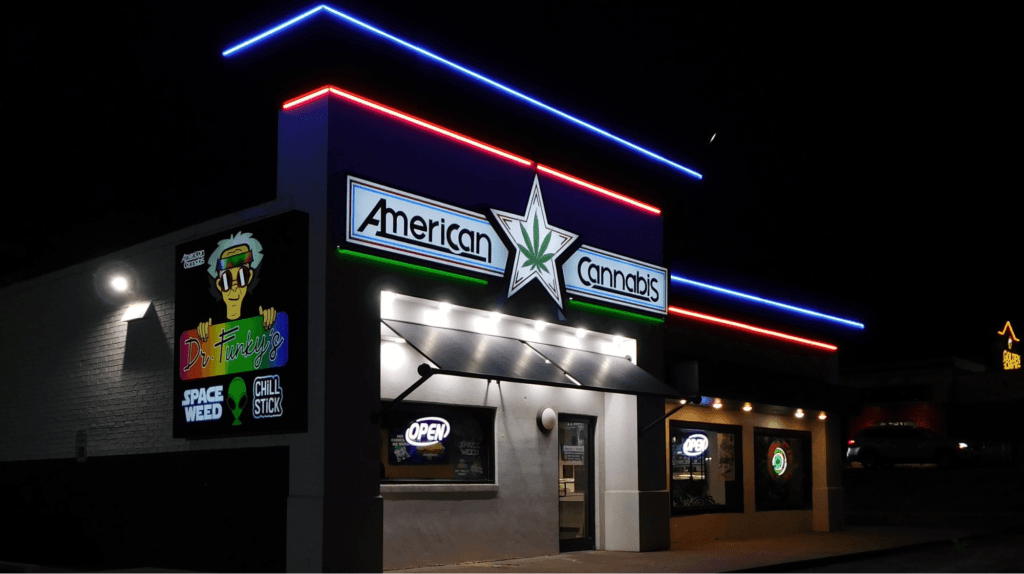
Once your OMMA card is approved, come see us. American Cannabis Company has 12 locations across the Oklahoma City metro area — in OKC, Warr Acres, Moore, Mustang, Chickasha, Lawton, Enid, Stillwater, and more. Every product on our shelves comes with a full strain description and terpene breakdown, and our trained budtenders are here to help you find exactly what you need.
First-time patient? You’ll receive $10 in store credit on your first visit.
All locations open 365 days a year · Mon–Sun 10:00 am – Midnight
Find Your Nearest LocationShop Online MenuMedical disclaimer: This article is for informational purposes only and does not constitute medical advice, diagnosis, or treatment recommendations. Always consult with a licensed physician before beginning any medical cannabis regimen. American Cannabis Company is a licensed Oklahoma dispensary and does not provide physician recommendations or medical consultations. Information about the OMMA application process reflects requirements current as of April 2026 — visit oklahoma.gov/omma for the latest official guidance.